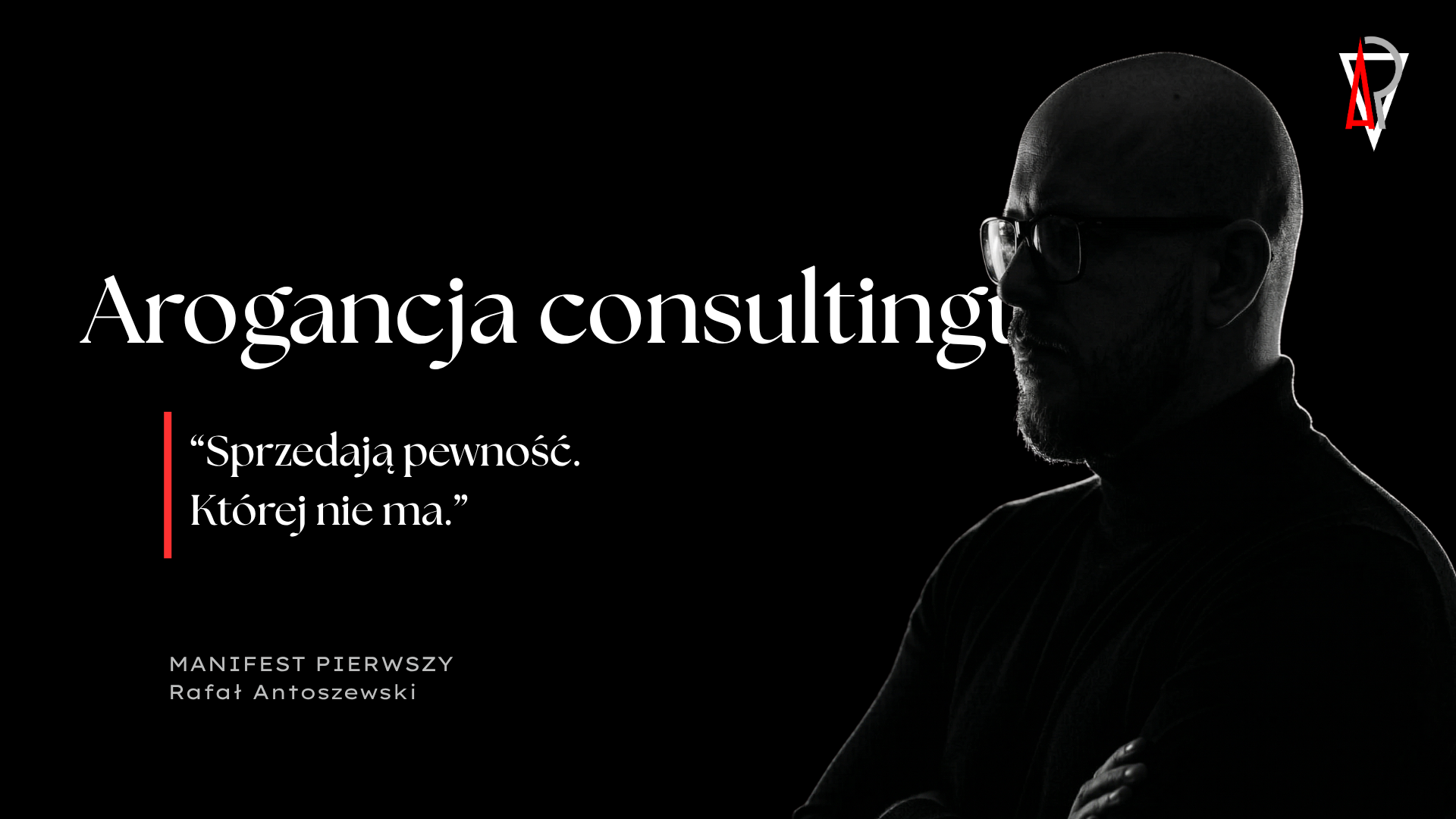
Arogancja consultingu.
Dlaczego twój doradca nigdy ci nie powie, że nie wie Sala konferencyjna. Po drugiej stronie stołu konsultant. Z renomą. Z dorobkiem publikacyjnym.…
Read (in Polish) →Organisational structure
Is your company growing faster than its organisation? Roles overlap, decisions get stuck and micromanagement kills initiative? I design structures that support the strategy, give people room and remove needless friction. Not an org chart for a frame — a way of making decisions.
Who it is for
The company has 40 people and every decision above a few thousand is made by one person. The bottleneck has a name.
Head of Sales and Head of Growth. Marketing and “new business”. Nobody knows who has the final say.
Two cultures, two sales teams, two CRMs. Someone has to decide what stays.
The structure that worked for one market won’t carry three.
How it works
How decisions are really made — not what the chart says. Conversations with leaders and teams, analysis of information flow.
Structure follows strategy: segments, processes, decision points. Only then positions and reporting lines.
For every role: what it owns, what it decides alone, what it escalates. No blind spots, no duplication.
Communication plan, sequence of changes, support for leaders in the first weeks. Changing a structure means changing habits — that takes time.
Formats
It doesn’t have to, and usually doesn’t. Most often it is about getting the people who are already there to stop getting in each other’s way. If the diagnosis shows that a role makes no sense — I will say so plainly, but the decision is always yours.
HR designs positions and career paths. I design the way the company makes decisions and delivers value to the customer — and the structure is a consequence of that. I work well alongside HR, not instead of it.
Diagnosis and target model: 2–3 weeks. Implementation: 2–4 months, because changing a structure means changing habits, and those don’t change with an all-hands announcement.
From the moment the founder stops being able to handle everything alone — usually 15–20 people. At 50+ people, a structure without a design almost always costs more than the design.
From the blog
Dlaczego twój doradca nigdy ci nie powie, że nie wie Sala konferencyjna. Po drugiej stronie stołu konsultant. Z renomą. Z dorobkiem publikacyjnym.…
Read (in Polish) →
Jeden handlowiec. 40% przychodu firmy. I właśnie odszedł. Właściciel powiedział: „Nikt nie przewidział, że odejdzie". Nieprawda. Wszyscy to przewidzieli. Nikt nie chciał…
Read (in Polish) →
Zatrudniliście go dziewięć miesięcy temu. Czterdzieści tysięcy miesięcznie. Dziś siedzicie na zarządzie i zastanawiacie się, czy dać mu jeszcze kwartał. To trzeci…
Read (in Polish) →Tell me where you are — we will work out whether and how I can help. 30 minutes, no commitment.